How to Read a Construction Plan : What Nobody Actually Explains
By Dan Thornton - BIM Draughtsman & Quantity Surveyor, dt-plans.com
You've received your construction plans. You laid them out on the table, nodded convincingly, and thought: "I have absolutely no idea what I'm looking at."
That's normal. Construction drawings don't explain themselves intuitively. They're not a dead language reserved for professionals either - they're a system of conventions that nobody takes the time to walk you through, because everyone assumes you already know.
This guide is here to fill that gap. Not to turn you into a draughtsman, but to give you the reading tools to follow your project, ask the right questions, and - most importantly - spot when something isn't right.
Start in the Right Place: the Title Block

Before you look at the drawing itself, find the title block - the information panel usually located in the bottom right corner of the sheet. It contains everything you need to correctly interpret what you're about to read.
The most important element is the scale.
A scale of 1:100 means that one centimetre on paper represents one metre in reality. At 1:50, one centimetre represents fifty centimetres. The smaller the second number, the larger and more detailed the drawing.
What catches a lot of people out is printing. A plan designed to be printed at A1 and printed on a standard A4 printer is no longer at the stated scale - every measurement you take with a ruler will be wrong. If you want to measure something physically on a plan, always check that the print format matches the format stated in the title block. When in doubt, rely only on the dimensions written on the drawing itself, not on anything you measure with a ruler.
The Three Fundamental Views

A building is a three-dimensional object. To represent it on paper, several types of views are used, and each one answers a different question.
The floor plan answers the question: what's where?
This is probably the view you're most familiar with - an imaginary horizontal slice taken at window height, showing the layout of rooms, wall thicknesses, and the position of doors and windows. Think of a dolls' house seen from above, with the roof removed.
This is the document where you check circulation between rooms, room dimensions, and partition placement.
The section answers the question: what are the heights?
This is a vertical view - as if the building were cut in two from top to bottom and you're looking at the interior face-on. This is where you read ceiling heights, slab thicknesses, roof structure, and the levels of different floors. It's an essential document for understanding how the building works vertically, which the floor plan alone won't show you.
The elevation answers the question: what does it look like from outside?
This is the exterior view of the building from each orientation. It shows openings, facade materials, relief, and levels. It's also the document submitted to the planning authority as part of the building permit application - it's what neighbours see and what the planning committee reviews.
What the Lines Tell You

On a plan, every line type has a specific meaning. You don't need to know all of them, but a few are genuinely worth recognising.
Thick solid lines represent elements that are cut through in the view - typically walls. The thicker the line, the more structurally significant the element. A load-bearing wall will be drawn thicker than a lightweight partition, and that difference isn't cosmetic: a load-bearing wall cannot be touched without a structural engineer's assessment. A lightweight partition is a different conversation.
Thin lines represent elements that are visible but not cut through - furniture, sanitary fittings, floor outlines.
Dashed lines indicate elements that exist but aren't visible in this view - a beam overhead, a void below, an opening in the floor slab. If you see a dashed rectangle on the ceiling of your future kitchen, that might be the intended position for the extractor hood - or a substantial structural beam you hadn't anticipated, which will determine the entire ceiling height of the room. This is often where the surprises hide for someone who doesn't know how to read them: a dashed line mistaken for a decorative element can conceal a significant structural constraint.
Reading Dimensions Without Getting Lost
The dimensions - the measurements written on the plan - follow a logic that's worth understanding.
On the inside, you'll find room dimensions: the clear internal sizes between wall faces, meaning the space that's actually available to you. This is where you check whether your sofa fits, whether the double bed has room, whether circulation is adequate.
On the outside, well-produced plans typically show three layers of external dimensions:
The first line, closest to the building, gives the opening dimensions - the widths of windows and doors, and the piers between them. This is the level that tells you whether a glazed door is actually 2.40 m or 1.80 m wide, and whether the wall between two windows is wide enough to be structurally coherent.
The second line gives the structural dimensions - the distances between the faces of load-bearing walls, without finishes or render. This is the reference that building contractors work from.
The third line, furthest from the building, gives the overall dimension - the total length or width of the building, everything included.
These three lines must be consistent with each other. If you add up all the elements in the first line - openings, piers, end wall thicknesses - you should arrive at the overall dimension. It's a quick and simple check that will immediately reveal an error or an omission.
A discrepancy of a few centimetres can seem trivial on paper - it can mean a standard kitchen unit won't fit, a door won't open fully, or a planned staircase doesn't have the legally required space.
Dimensions are generally expressed in centimetres on standard plans, sometimes in metres on site plans. Check the unit - confusing the two is more common than you'd think.
Questions to Ask Before You Sign Off
A validated plan is a commitment. What's drawn will be built. What isn't drawn won't be - and unpicking things once the concrete is poured is expensive.
There's also an important distinction worth knowing: professionals refer to Design Intent drawings and Construction drawings. The former are used to develop the project and obtain planning permission - they're what you receive at permit stage. The latter are used to order materials and direct contractors on site - they're far more detailed and arrive later in the process. When you're asked to approve drawings, know which stage you're at: the responsibility isn't the same.
Before you sign off, ask yourself:
Does the circulation work? Take the plan and mentally walk every daily route - bedroom to bathroom, entrance to kitchen, kitchen to terrace. Do the doors open the right way? Is a corridor too narrow for two people passing each other?
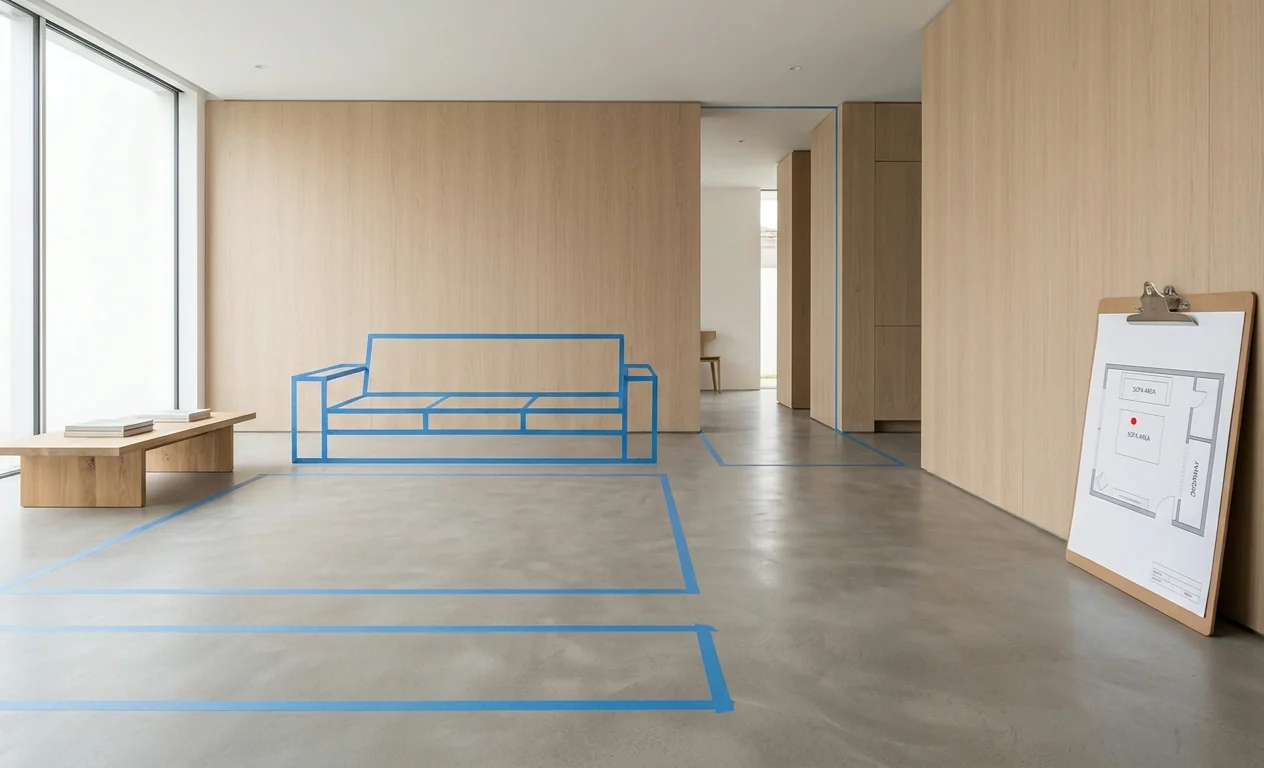
Better still: make the space physical. A plan at 1:100 is small. The human brain is poor at translating centimetres on paper into real metres - we systematically overestimate small spaces and underestimate large ones. If you're unsure about a room, mark it out on the floor with masking tape and walk around in it. Ten square metres on paper and ten square metres in real life are often a surprise. Some companies now offer real-scale floor projection services - the plan is projected directly onto a floor or slab at full size. It's still relatively rare, but if you're hesitating over the layout of an important room, it's worth tracking down.
Do your furniture fit? A standard sofa is around 2.20 m long. A double bed is at least 1.60 m wide. A wardrobe is 60 cm deep. Project your current furniture into the plans before signing off on room dimensions.
Where's north? Orientation determines natural light throughout the day. A bedroom facing west will be pleasant in the evening but overheated in summer. A living room facing north will stay cool but dark. That's not a plan error - it's a matter of making an informed choice.
Are the levels consistent? If you have a terrace, a level entrance and an interior slab, check in section that the levels connect logically. An unexpected step between the living room and terrace won't show on the floor plan - it shows on the section, and you'll live it on site.
What a Plan Doesn't Tell You
A well-read plan gives you a precise picture of what's going to be built. But there are things it doesn't contain that are worth anticipating.
Permit drawings and construction drawings are not the same documents. A building permit contains relatively general plans - site plan, elevations, floor levels. Construction drawings contain the detail of every junction, every material, every technical sleeve. If you're only being shown permit drawings for sign-off, that's normal at this stage - but understand that the level of detail you're seeing is not the final level.
Services - electrics, plumbing, ventilation - rarely appear on standard architectural drawings. They have their own separate technical plans. If you haven't seen them, ask.
In Summary
Reading a plan doesn't require technical training. It requires knowing what to look for and in what order.
Start with the title block and the scale. Identify the type of view. Spot the load-bearing walls. Check the dimensions. And before you sign off, put yourself physically in the space - not with an architect's eye, but with the habits of someone who's going to live there.
A plan is a contract. The more you understand it upfront, the fewer surprises you'll have once the work starts.
You've received plans and you're not sure you've understood everything? I offer a technical review of your documents - to identify the points worth checking before work starts. No commitment, quick turnaround.